
Basic usage
The vassi package provides functions and classes for a complete behavioral classification pipeline. In the following example, we break down a minimal example of running the entire pipeline on the CALMS21 dataset. You can find the full notebook on one of the next pages.
First, we load the CALMS21 training dataset:
from vassi.config import cfg
from vassi.io import load_dataset

# set configuration keys (see case_studies.calms21.convert for details)
cfg.key_keypoints = "keypoints"
cfg.key_timestamp = "timestamps"
cfg.trajectory_keys = ("keypoints", "timestamps")

dataset_train = load_dataset(
    "mice_train",
    directory="../../datasets/CALMS21/train",  # set directory
    target="dyad",
    background_category="none",
)

# remove all dyads in which the intruder mouse is "actor"
dataset_train = dataset_train.exclude_individuals(["intruder"])
Hint
In the vassi package, the first individual in a dyad is called “actor”, and the second individual is called “recipient”. A group usually consists of all pairwise combinations (dyads) of individuals.
Then, we can create a feature extractor to sample the dataset.
Note
Feature extraction can be cached by specifying the cache_mode argument to either True or 'cached'. For the latter, feature extraction requires already cached feature files. You need to specify cache_directory in both cases.
Caching can help you to avoid recalculation of features for the same individuals or dyads and is aware of the feature extractor configuration.
from vassi.features import DataFrameFeatureExtractor

extractor = DataFrameFeatureExtractor(cache_mode=False)
extractor.read_yaml("features-mice.yaml")
With this extractor, we can compute the defined features for all dyads in the training dataset. For this quick example, we subsample the dataset so that each behavioral category is represented with 1000 samples each. This produces a DataFrame for the features, and a ndarray containing corresponding labels.
Note
Have a look at the documentation for more details on subsampling. Here, we use the default arguments for stratified subsampling that ensures that each dyad (and each behavioral interval) is proportionally represented in the resulting samples. You can fix the random state to ensure reproducibility.
X, y = dataset_train.subsample(
    extractor,
    size={category: 1000 for category in dataset_train.categories},
    random_state=1,
)
y = dataset_train.encode(y)  # Encode the labels to integers
Now, we can train a model on the subsampled dataset. For this basic example, we choose a RandomForestClassifier from the sklearn ensemble module.
from sklearn.ensemble import RandomForestClassifier

classifier = RandomForestClassifier(random_state=1)
classifier.fit(X, y)
Until now, the example only used the training dataset. Let’s load the test dataset for evaluation and use the fitted classifier to predict on all dyads.
from vassi.classification.predict import predict

dataset_test = load_dataset(
    "mice_test",
    directory="../../datasets/CALMS21/test",  # set directory
    target="dyad",
    background_category="none",
)
dataset_test = dataset_test.exclude_individuals(["intruder"])

result_test = predict(dataset_test, classifier, extractor)
The resulting object result_test (a DatasetClassificationResult) holds the true and predicted labels for each dyad, for all timestamps (video frames), but also aggregated as intervals for predictions and annotations (both as properties that return a DataFrame).
Since we predicted on the entire test dataset, the result is a nested object that contains predictions for each group (video sequences of the CALMS21 dataset, see GroupClassificationResult) and each dyad (only one dyad per group: ('resident', 'intruder'), see ClassificationResult).
These result objects provide easy access to evaluation metrics (inherited from BaseResult), such as f1_score() and confusion matrices. We can also visualize predictions as behavioral timelines.
from vassi.classification.visualization import (
    plot_confusion_matrix,
    plot_classification_timeline,
)

plot_confusion_matrix(
    result_test.y_true_numeric,
    result_test.y_pred_numeric,
    category_labels=result_test.categories,
)

result_group = result_test.classification_results[10]
result_dyad = result_group.classification_results[("resident", "intruder")]

plot_classification_timeline(
    result_dyad.predictions,
    annotations=result_dyad.annotations,
    categories=result_dyad.categories,
    y_proba=result_dyad.y_proba,
    timestamps=result_dyad.timestamps,
)
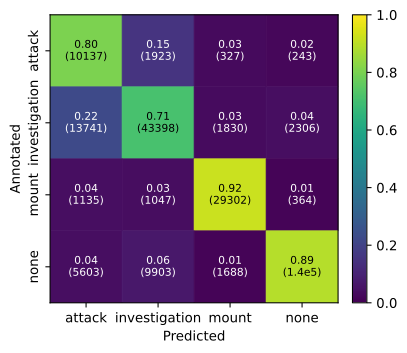
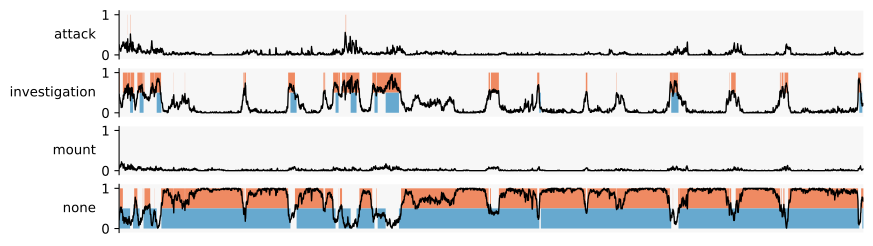
Although we only trained a simple model on a subset of 4000 samples, the model already seems to classify the majority of the frames correctly.
You can fit any classification model that implements the sklearn predictor API to improve classification results, for example also xgboost classifiers. The vassi package further provides two postprocessing steps to improve classification results, output smoothing and thresholding. Have a look at the example notebooks to reproduce the results as presented in the paper.